Strategy 11 Measure biking and micromobility ridership levels and user comfort.
The actions within this strategy are divided into two categories:
Action we will DOActions we will SUPPORTAction we will do are followed by “DO” and are colored in dark gray, and actions we will support are followed by “SUPPORT” and are colored in light gray.
Learn more about how we get thereBuilding out a safe and convenient bike network will require monitoring, including impacts of investments on perceptions and use patterns of existing and new riders. In so doing, we will be able to adjust our approach if needed in light of user preference and use patterns.
Being able to help public understanding of new micromobility options through data – including use data, crash data, and travel behavior choices – will help the public better react to the changing mobility options as well as give people more information for their own journey.
Actions to measure biking and micromobility ridership levels and user comfort.
Bicycling 11.1
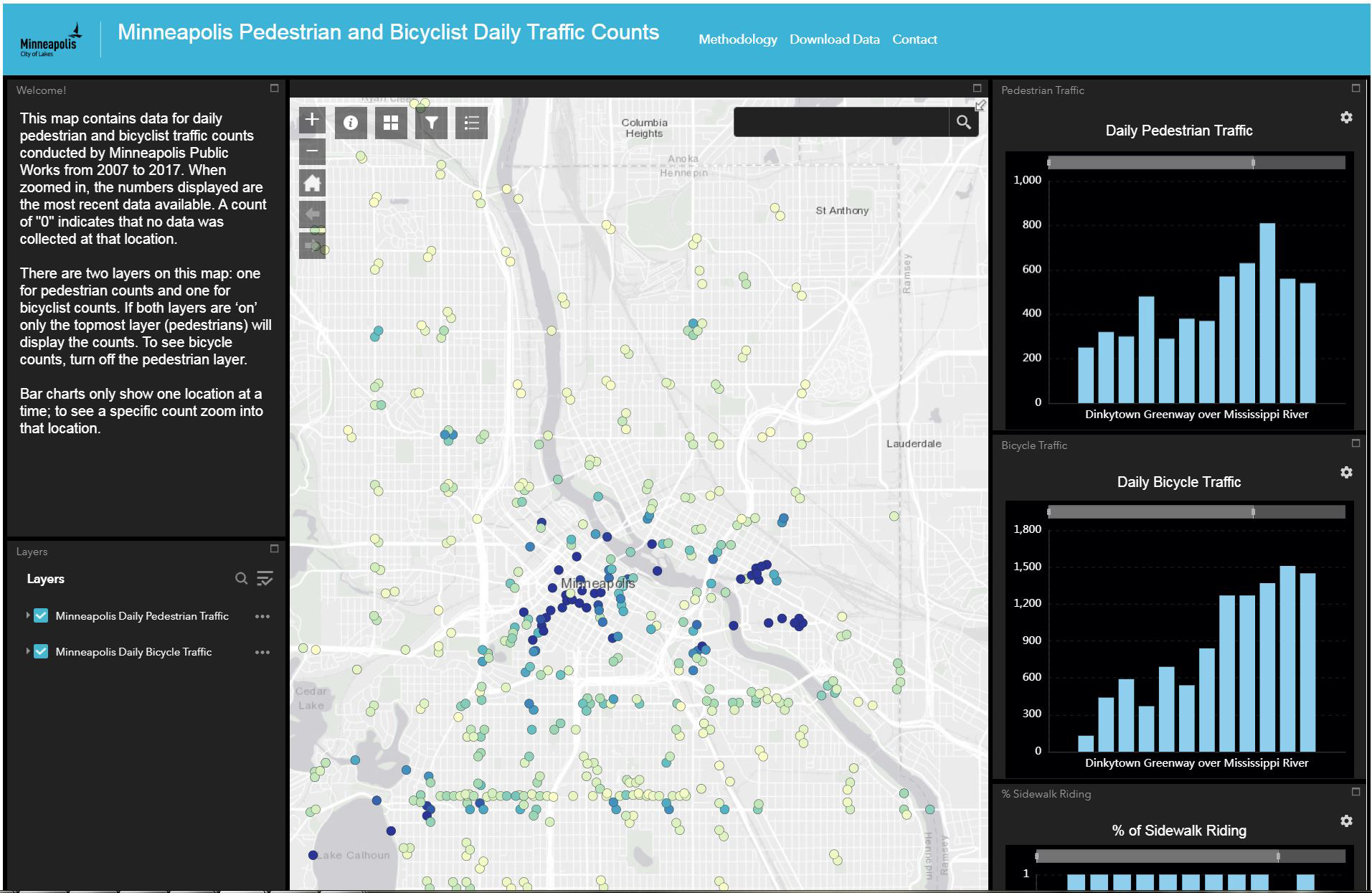
Expand use of automated counters to measure seasonal traffic variation and integrate biking and micromobility count data into traffic databases.
Supported goals:
Mobility
Related actions:
Difficulty:
Low
Timeframe:
2020-2023 (Years 0-3)
Status:
Successfully completed to date and on-going
Significant milestone(s):
Public Works is taking advantage of emerging technologies to strategically expand the use of automated counters, with two new counters installed in 2024 at Bryant Ave/35th St and the south end of the Minnesota Senate Majority Leader Kari Dzeidzic Memorial Bridge (10th Ave bridge over the Mississippi River). These new counters have significantly improved reliability and reduced maintenance requirements compared to types that have been used in the past.
Bicycling 11.2
Require data sharing from micromobility service providers to understand travel behavior and inform infrastructure and policy changes.
Supported goals:
Mobility Active Partnerships
Related actions:
Technology 4.1, Technology 4.2, Technology 4.3, Technology 4.4, Technology 4.5
Difficulty:
Low
Timeframe:
2020-2023 (Years 0-3)
Status:
Successfully completed to date and on-going
Significant milestone(s):
As of 2021, data sharing requirements are included in all service provider license agreements.
Bicycling 11.3
Conduct a biennial survey in coordination with micromobility service providers to collect information on the perceptions of biking and micromobility including who is riding and the experiences of people riding.
Supported goals:
Mobility Active Partnerships
Related actions:
Technology 4.1, Technology 4.2, Technology 4.3, Technology 4.4, Technology 4.5, Technology 7.4
Difficulty:
Low
Timeframe:
2020-2023 (Years 0-3)
Status:
Successfully completed to date and on-going
Significant milestone(s):
The City conducts annual scooter user surveys. In 2021 and 2024, the City conducted a bike and scooter survey.